99.8%reduction
Glyphosate. Measured before and after treatment by chromatographic analysis.
How pesticide residues and foodborne pathogens behave on fresh produce, why standard washing resolves neither, and what works better.

Biologics, corticosteroids and antimetabolites reduce the body's defense against foodborne pathogens as a direct consequence of how they work. It is on the label. It is rarely on the agenda in a fifteen-minute appointment.
Read section 1If you have been removing foods one at a time and logging outcomes, there is an input in that system you have almost certainly never controlled.
Read section 2Most patients who arrive here have removed considerably more than any clinician asked them to. There is a specific reason that happens, and it is not evidence.
Read section 7
Autoimmune disease is the immune system attacking the body's own tissue. The therapies that control it work by suppressing that response, and they do not suppress it selectively.
TNF inhibitors and other biologics interrupt specific inflammatory signalling pathways. Corticosteroids broadly dampen immune activity. Methotrexate and related antimetabolites reduce immune cell proliferation. Each produces the intended effect on disease activity. Each reduces the body's capacity to contain a pathogen it encounters.
This appears in the prescribing information for these agents. Serious infection risk is a labelled warning for the TNF-inhibitor class, with Listeria named among the organisms of concern.2
CDC guidance on food safety for people with weakened immune systems explicitly includes people taking immunosuppressive medication, alongside patients undergoing cancer treatment and transplant recipients.1
The practical consequence: organisms a healthy immune system clears before symptoms appear — E. coli, Salmonella, Listeria monocytogenes — meet a reduced response.
What patients consistently report is that nobody walked them through it. Rheumatology and gastroenterology appointments are dense and short. Most patients reach this topic on their own, years in, usually through another patient.
The second reason patients arrive here has nothing to do with acute infection.
In November 2025, a University of Cambridge group published in Nature Microbiology a screen of widely-used chemicals against bacteria that populate a healthy human gut. 168 of them caused harm.3
The finding that matters most is one layer down, in the explanation of why this had not been established earlier.
Chemical safety evaluation does not assess gut microbiome impact. Structurally, it never has. A compound is tested against the organism it is designed to act on — an insecticide against insects, a fungicide against fungi. The bacterial populations that regulate human immune signalling were never inside the assessment boundary.
This is not a conspiracy. It is a scope gap. The question was not asked.
A companion multi-omics study from Ohio State and Yale, published in Nature Communications in May 2025, mapped 306 pesticide–gut microbiota pairs. Residue exposure altered production of short-chain fatty acids, bile acids and tryptophan metabolites — compounds governing gut lining integrity and inflammatory signalling. Certain gut bacteria were found to take these compounds into their own cells and retain them after the meal had passed.4
Neither study shows that pesticide residue causes autoimmune disease. Neither shows that reducing residue exposure changes symptoms, inflammation, or antibody levels in any patient. That research has not been done.
What they establish is narrower: there is a plausible mechanism by which an input most people do not control could influence a system they are trying to measure. That justifies controlling the input. It does not support a conclusion about outcomes, and this page does not make one.
For patients running structured elimination protocols, this has a specific implication. If produce is treated as a fixed input and rinsing is assumed to handle what is on it, every trial in that protocol has been running with an uncontrolled variable inside it.
The reasonable response is to wash more carefully — longer rinses, scrubbing, a commercial spray. This handles visible soil well. Neither of the two things that matter here is visible soil.
Agricultural pesticides are formulated to be hydrophobic. A compound that rinsed off in rain would offer no crop protection. These molecules bond to the waxy cuticle of produce. Water beads and runs off that cuticle without breaking the bonds, which is why rinse duration has little effect.
The scale of what survives is documented in the USDA Pesticide Data Program: across 54,344 samples, 96% of Dirty Dozen produce still carried detectable residue5 — and the protocol washes samples before testing. That figure is not what is on produce before you clean it. It is what remains after.
Listeria, Salmonella and E. coli form biofilms — protective matrices anchored into the microscopic pores of produce surfaces. Cantaloupe netting, strawberry seed pits, the stem well of a tomato, the folds of leafy greens. Scrubbing improves surface coverage and cannot enter a pore narrower than a bristle.
Certified organic production permits a defined list of synthetic substances under federal rule eCFR §205.6016. The label constrains which compounds may be used; it does not mean none were. And organic certification says nothing about bacterial contamination, which enters through soil, water, handling and transport rather than through chemical application.
| Method | Active agent | Pesticide removal | Biofilm penetration | Contact time | Sensory impact |
|---|---|---|---|---|---|
| Tap water | Friction / dilution | Low | Poor | Instant | Neutral |
| Vinegar soak | Acetic acid | Moderate | Poor | 10–30 min | Sour taste and odor |
| Baking soda | Sodium bicarbonate | Moderate | Moderate | 12–15 min | Gritty residue |
| Commercial wash | Surfactants | Moderate | Moderate | Instant | Detergent residue |
| Electrolyzed water (EOW) | HOCl + hydroxyl radicals | High | Excellent | 10 min, automated | None |
Vinegar requires 10–30 minutes of contact for meaningful bacterial reduction, does not penetrate biofilm effectively, and cannot degrade hydrophobic pesticide bonds. Residual taste is a genuine barrier for patients with GI-driven food aversion.
Baking soda is the best-studied home method. A 2017 University of Massachusetts study in the Journal of Agricultural and Food Chemistry7 found it outperformed tap water and dilute bleach — and also found that after a full 12–15 minute protocol, residues that had already penetrated the peel could not be removed by any surface method.
Commercial washes are surfactant-based. USDA advises against soap on produce because porous skins absorb it,11 and published comparisons generally show these products performing no better than water.
Cooking everything eliminates the pathogen question at the cost of heat-sensitive vitamins and the option of eating fresh food — a meaningful loss for a population already managing restricted diets.
Commercial food processing addressed this decades ago. Pre-cut salad packaging, seafood processing and institutional food service use electrolyzed oxidizing water as standard practice.
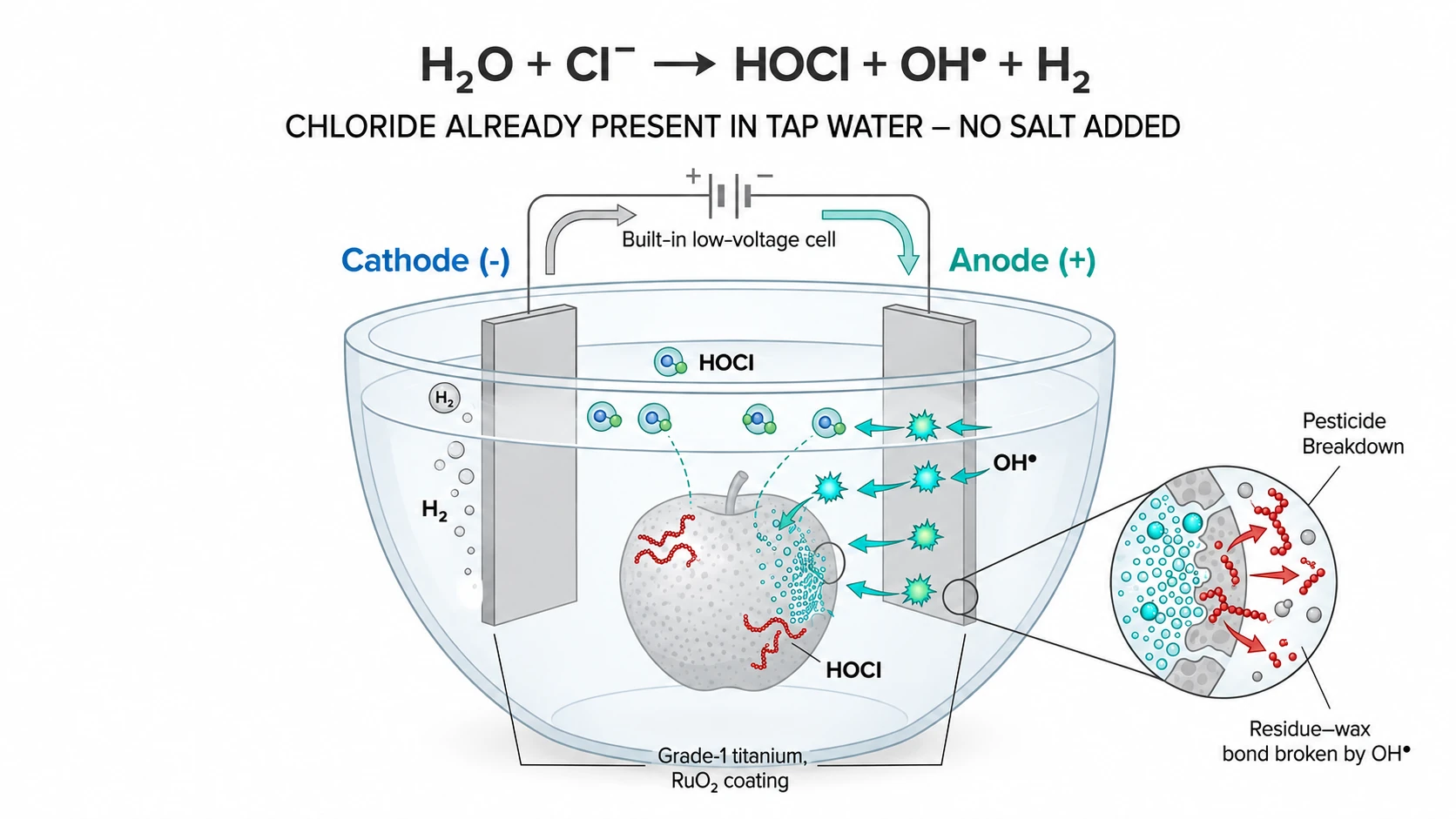
Running a low-voltage current through water generates two species.
HOCl is the compound human neutrophils produce as part of the innate immune response. Not a synthetic disinfectant that resembles something biological — the same molecule, generated outside the body rather than inside it.
Carrying no charge, it crosses the negatively charged cell walls of bacteria rather than being repelled. It is approved for direct food contact in commercial processing, leaves no residue, and reverts after the cycle.
Immunosuppressive therapy reduces activity of the neutrophil-mediated response that produces HOCl inside the body. Electrolyzed water produces the same compound in a bowl of water, before food is eaten.
It performs no function inside the body and replaces nothing the immune system does. The overlap is limited and specific: one job, in one place, outside the patient.
Short-lived, highly reactive — oxidation potential 2.80V, second only to fluorine. They attack the carbon bonds of pesticide molecules, breaking the adhesion between residue and the waxy cuticle that water cannot disrupt.
The process simultaneously generates micro-bubbles that lower surface tension, carrying the oxidizing species into pores and crevices no brush enters.
No salt is added. Devices requiring added sodium chloride generate their chemistry from the salt. A properly specified unit works from plain tap water.
Hao et al., Journal of Food Science, 20118 — electrolyzed water on fresh vegetables, 59–86% pesticide reduction depending on compound, outperforming tap water and commercial detergents, with no reduction in vitamin C.
Qi et al., Food Chemistry, 20179 — electrolyzed oxidizing water on spinach, snap beans and grapes, removing up to 86% of the pesticides tested depending on compound and produce.
Studziński et al., Molecules, 202410 — electrolyzed water as produced by consumer kitchen devices; confirmed reduction across multiple categories and documented the limit on fat-soluble compounds.
Most of this product category blurs this line. This page draws it.
Method — Grade-1 titanium electrolytic unit, 2.5 L water volume, 10-minute cycle.
Where a number cannot be sourced, none is given.
No washing method of any kind renders food sterile or eliminates infection risk.

There is a third route to this page, and it is the most common one.
Patients managing autoimmune disease frequently arrive having removed far more from their diet than any clinician asked them to. Gluten, dairy, nightshades, seed oils, then pre-washed greens, then restaurant salads, then berries, then most raw produce.
Very few of those removals are clinically indicated. Nearly all of them feel like they are.
The mechanism is the one this page opened on. Washing produce yields no verdict, so the question cannot be closed. Removing the food is the only move available that produces a definite result — so the anxiety gets resolved the one way it can, and the diet narrows by one item.
Repeated over several years, that produces a diet built out of a dozen or more self-imposed subtractions, with measurable consequences: reduced fiber intake, narrowed micronutrient range, and loss of most raw plant intake. Registered dietitians working with autoimmune populations report this pattern routinely.
The realistic objective is not sterile food. That does not exist for anyone. It is a repeatable step that closes the question, so that removal stops being the only available answer to it.
Guidance written for cancer caregivers assumes a well person is preparing the food. Here, the person managing the food is usually the patient.
Symptom variability makes manual protocols unreliable. A twenty-minute scrubbing routine is achievable on a good day. Hand involvement in rheumatoid arthritis, a fatigue day, an active flare — the routine degrades precisely when consistency would matter most. A method that runs identically regardless of how the patient feels is not a convenience feature in this population.
GI sensitivity makes residual taste a barrier. For IBD patients in particular, food aversion is part of the clinical picture. A method leaving vinegar odor or detergent residue on delicate produce gets abandoned within weeks.
Protocol fatigue is real. Patients arriving here have often been subtracting for years. Adding another manual ritual to an already heavy routine has a poor completion rate; automating an existing one does not.
The category was contaminated early by low-quality imports, and the failure mode is specific enough to screen on.
Cheap units use iron or stainless electrodes that corrode during operation. The brown water that appears in demonstration videos, widely read as proof of extracted contamination, is iron oxide — the electrode dissolving into the water and onto the food.
High-grade units use Grade-1 titanium with a ruthenium oxide coating — the Mixed Metal Oxide / Dimensionally Stable Anode class used in industrial water treatment. These do not corrode.
Run the device in plain water with no produce in the bowl. A titanium unit produces clear water with fine white micro-bubbles. An iron-electrode unit produces brown water.
Whatever appears came from the device, because nothing else is in the bowl.
Produce goes into a bowl of tap water with the device. The cycle runs 10 minutes. Water is discarded and produce briefly rinsed. Nothing is added to the food and nothing remains on it.
Scrubbing relocates contaminants across a surface and cannot enter a pore. Electrolytic purification generates chemistry that travels wherever the water travels.
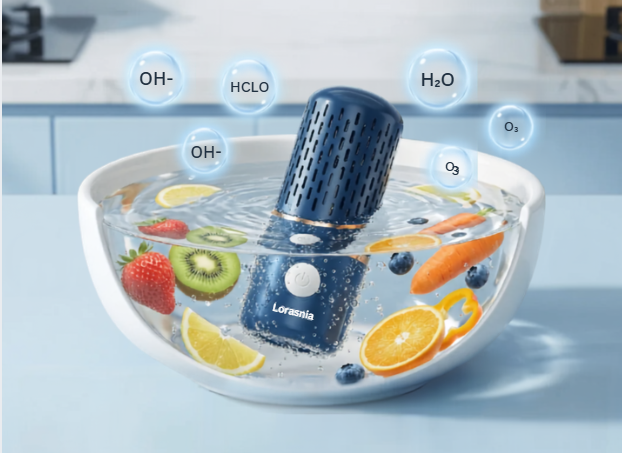
One consumer device meeting the specifications described in Section 09.
FreshGuard is not sold on Amazon. All Amazon listings using the Lorastia name are unauthorized. The counterfeits are iron-electrode units — the specific failure mode described in Section 09. Order only from the official site.